
In 2015, reeling from the public backlash to its namesake’s request for a private jet, “prosperity gospel” preacher Creflo Dollar’s ministry requested funds for a new initiative to “reach a billion souls for Jesus.” While the original webpage is no longer active, The Christian Post reported that the message stated, “As you take the equivalent of the widow’s mite, and give it to God to impact billions with the Gospel of grace, you can expect grace explosions to take place in your life.”
Similarly, Kenneth Copeland Ministries has appropriated the famed widow’s mite. In a devotional that has made the rounds on their socials (the most recent I found was a 2022 Facebook post from the European wing of their ministry), the ministry explained that it was not what the widow gave but how she gave that got Jesus’s attention: “What moved Jesus wasn’t just the fact that she gave. It was how she gave. She gave in faith–not in fear. She didn’t stop and calculate what she didn’t have and say, ‘Boy, if I do this, tomorrow I won’t eat.’ She just boldly threw in all she had, expecting God to take care of her in return.”
But here’s the really good news according to Copeland: “If you have a need right now, get God’s attention by giving with boldness like that widow woman did. Throw open the door of your household by throwing everything you have at Jesus. Let God know that He is your source. Before long, the abundance of God will come pouring in!”
In other words, if you mix the heart of the widow’s mite with the result of the loaves and fishes, then voilà—you get personal prosperity.
This is the promise of the prosperity gospel: If you give—especially out of your want—you will receive back from God in abundance. But what this reading misses about the widow’s mite is more telling than we realize.
What is the Prosperity Gospel?
The Prosperity Gospel is the term given to a theological movement—one especially associated with some (though by no means all) charismatic church trends, such as the Word of Faith movement—that treats material prosperity and physical wellness as signs of God’s favor, particularly earned favor for bold faith that might seem reckless from a “worldly” perspective. These are something like contractual financial interactions, although the divine “exchange of goods” may be null and void if the one seeking God’s favor does not give with strong faith. This is often used as an excuse when the promises of a prosperity preacher do not pan out in the life of someone who gave their last penny to the cause.
More than an add-on to the faith, this understanding of prosperity is understood as an integral part of the life of a Christian. This novel idea may have begun in America with Russell Conwell’s late nineteenth-century sermon, “Acres of Diamonds,” which equated worldly success with spiritual blessing. The movement more fully emerged in the 1950s with the success of Oral Roberts and entered the American mainstream through the advent of televangelism ministries. Missionaries successfully transplanted it abroad in the global South and it remains particularly popular in American urban and otherwise socioeconomically depressed areas, and in migrant communities. In other words, it is quite powerful among those who are under serious financial, physical, social, and psychological pressure—precisely the people most vulnerable to its abuses.
Interestingly, this principle is both upheld and directly challenged in the Bible. Of course, under ideal circumstances, those who act according to God’s will shall reap blessings, and those who don’t will face consequences. This was particularly true within the covenantal framework of Israel and will be true in the end of those who followed the Lord in faithfulness and those who did not. But alas, this principle holds true under “ideal” circumstances, which are increasingly fleeting since the fall of humanity in the Garden. Material blessing is always that: a blessing. Not a due payment. Not a debt God owes us for being moderately kind. And not, it must be understood, a guarantee in the life of a Christian. At times, Christ seems to guarantee something quite different (Matt. 10:22; Mark 8:34-35; John 15:18-20, 16:33).
Within the text of Scripture, we are confronted with the realities of this world. How long shall the wicked prosper (Psalm 94:3-7)? Why are the good servants of God killed (Gen. 4:8; Matt. 21:33-41; 23:29-39)? And this “retribution principle,” which one might liken to the modern concept of instant karma for our daily moral choices, is directly challenged in the book of Job, as Old Testament scholar John Walton explains. The retribution principle is “proverbial in nature,” he writes, meaning that “it’s how things often act but not how things always work.” It cannot be used to explain material wealth and physical wellness, nor can it be used to explain material poverty and physical illness. At least, not always. To pretend it does assumes the one making the claim has unending access to the mind of God. And this whole notion is tossed on its head by Paul the Apostle, along with the whole early Christian world, which finds it a blessing to share in the sufferings of Christ (Phil. 3:10; 1 Pet. 4:13). Offering the blessing of suffering like Christ, however, would not be the most successful marketing campaign for your next jet, though.
The Story of the Widow’s Mite
Before Jesus saw the widow in the Court of Women within the temple complex, he had already made an appearance at the temple. After entering Jerusalem, he and the disciples had gone there and interacted in the Court of Gentiles (the outer court). That time, Jesus had warned people about certain Jewish authorities—who would have been there listening to him—and eventually chased people out of the temple.
The next morning, the disciples see a dead fig tree that Jesus had cursed the day before because it had leaves but no fruit. Since they last saw it, it had withered and died. This was an indictment on the temple and its leaders—all the appearances of being a spiritually alive house of the Lord, yet nothing but injustice and decay on the inside. After Peter pointed out the withered fig tree, Jesus tells them to strengthen their faith in God.
Jesus made his way back to the temple that day. He would not have been a welcomed sight to the religious leaders. He won’t play their games. He won’t tell them where his authority comes from. He teaches in piercing parables. He foretells his death by those who are rejecting God, and he says that the power of God will strike them down (Mark 12:9). The Jewish leaders know he is talking about them. They seethe. They want him dead. They plot his arrest. Instead of lashing out in political revolt as other rebels had done, he tells people to love God and their neighbors (Mark 12:30-31).
A crowd gathered around him that including Sadducees, Pharisees, and teachers of the Law. They try to stump him with their questions, but he outmaneuvers them at every step. He then says, with the crowd of self-righteous religious leaders surrounding him, “Watch out for the teachers of the law. They like to walk around in flowing robes and be greeted with respect in the marketplaces, and have the most important seats in the synagogues and the place of honor at banquets. They devour widows’ houses and for a show make lengthy prayers. These men will be punished most severely” (Mark 12:40).
Take note: They devour widows’ houses. There had been a practice at the time, described in later years by Bede (672-735) and Theophylact of Ohrid (1050-1107) who apparently received this information from documents and traditions we no longer have direct access to. They tell us that certain hypocrites, Scribes, and other “trusted” authorities would go to the houses of widows (which had no protection from husbands or adult children) and prey on them by offering to pray for them and tell them pleasant things about their prospects. They came dressed to the nines. And for this service of visiting the widows, of course, they extracted money until none was left.
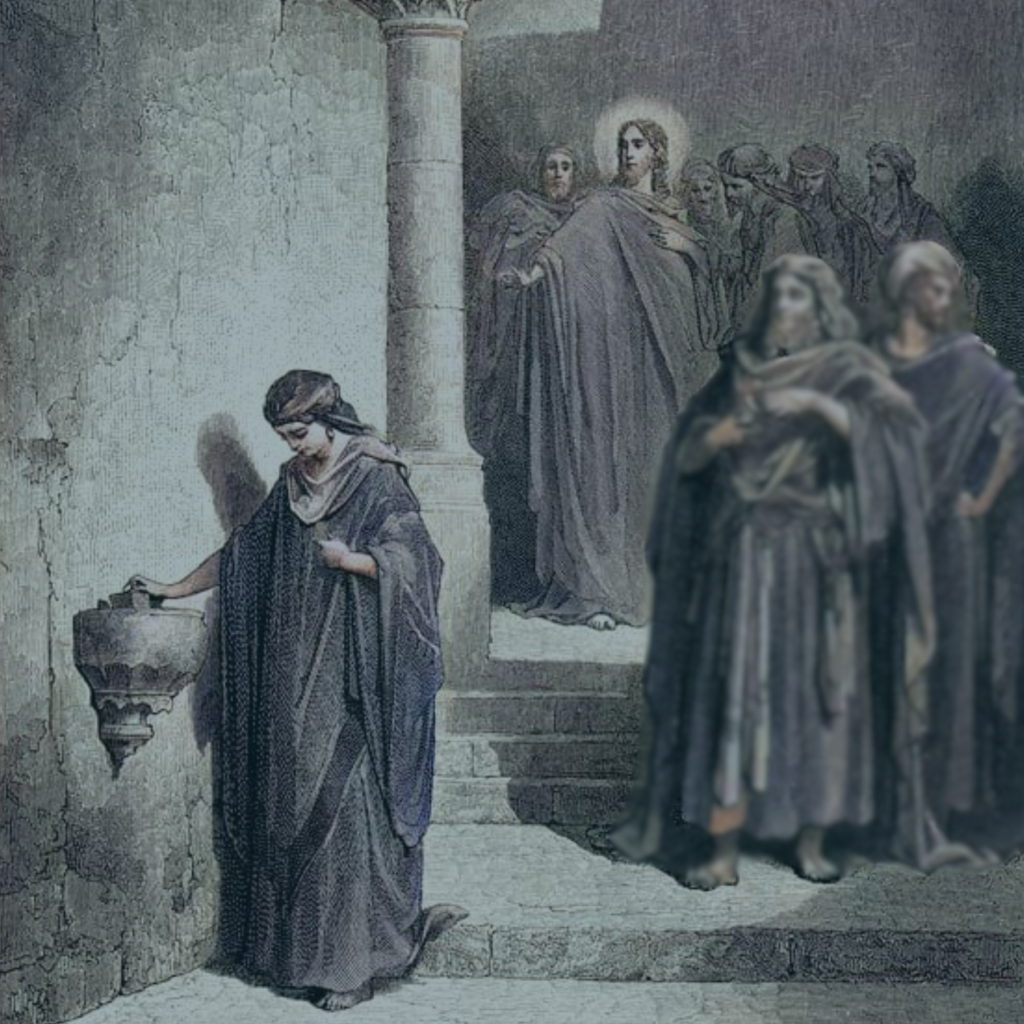
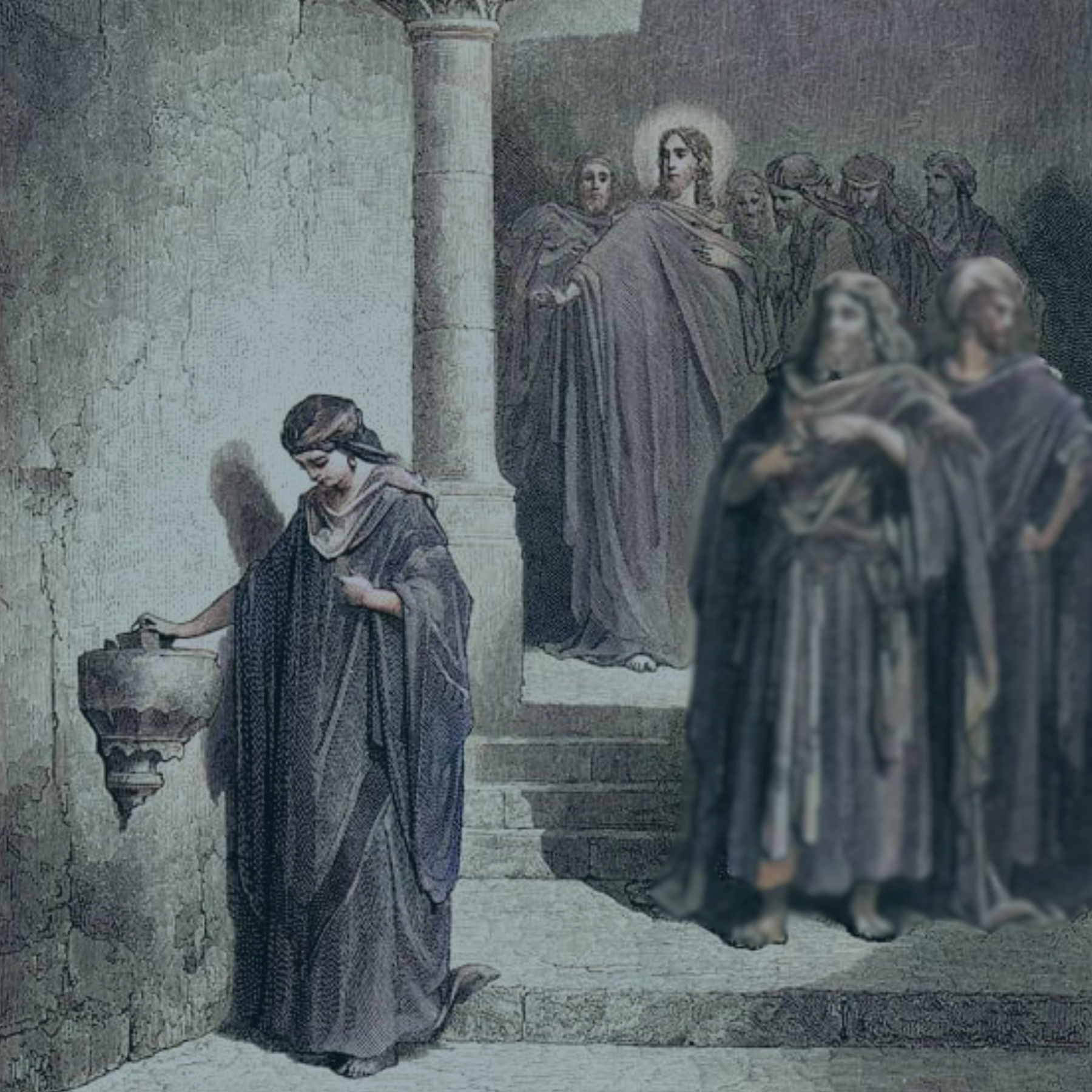
Immediately after warning about those who devour, Jesus sees the widow giving her two mites. In this section of the temple there were thirteen collection boxes called “the Trumpets” (or the treasury). Many people would come and drop large amounts of coins into the trumpets, making a lot of noise, bringing attention to their generosity. A mite, in Greek lepton, which means “thin one,” was the smallest denomination of money at that time. No one would have heard her donation.
And no one would have seen her most likely. She was not a person of stature. The fact that she is so destitute not only speaks to her lack of a husband, but also perhaps her lack of children.[i] She is seemingly alone in the world and has just given every single ounce of her money away.
Right after this, Jesus and the disciples exit the temple. As they are leaving, one of the disciples marvels at the temple’s beauty. Jesus replies, “Do you see all these great buildings? Not one stone will be left on another. Every one will be thrown down” (Mark 13:2).
What the Story of the Widow’s Mite Is Really About
Traditionally, this story is taken as a tale about the beauty of selfless giving. That’s certainly the interpretation of prosperity preachers. And in some respect, it is correct. The widow’s heart puts the heart of the religious elite to shame. But there is more going on here. She gives from her want without show; they take though they have abundance, which they flaunt before crowds.
If you’ve ever read this and thought to yourself, I don’t know … I feel a little uneasy with the widow being left penniless, you are not alone. And I think Jesus saw the same issue.
Mark does not place these scenes side by side by accident or coincidence. Jesus condemns leaders who ‘devour widows’ houses,’ and then immediately watches a widow place her whole livelihood into the temple treasury. The juxtaposition is the interpretation. Perhaps she had already encountered men who consumed her livelihood under the guise of piety and powerful prayers. And now she comes to the House of God, where the devouring continues.
Nor is it a coincidence that, immediately following the widow’s donation, Jesus foretells the destruction of the temple itself—a judgment fulfilled in AD 70 when not one stone was left upon another (Mark 13:2). Yet the temple’s coming destruction also pointed beyond itself. For even as Jesus spoke of the fall of that earthly sanctuary, He was also revealing a deeper reality: His own body was the True Temple they had failed to recognize. The old house that consumed widows would be torn down; the new and living Temple would be raised up in three days (John 2:19-21). Those who devoured houses will have their own house devoured.
So while the story is partly, look at how good this woman is, it is also look at how corrupt this system is because of the sinfulness and self-righteousness of its representatives. Not everyone was in charge of the temple, but everyone was implicated. Craig Evans explains that what Jesus says about the widow is “no word of praise; it is a lament. Instead of being assisted by the temple establishment, as the Law of Moses commands, the poor widow has been exploited by the temple establishment and reduced to abject poverty.”[ii]
What the temple establishment let fall into disrepair, and what prosperity preachers seem to either ignore or be completely unaware of, is the provisions in the Mosaic Law for people in the widow’s state. The Law in general made provision for widows in many places, providing something of a social security net for them. But the laws Evans is referring to are mentioned in Deuteronomy 14, 16, and 26, which state that tithes should be shared with widows in need, as well as provision for them at major religious feasts. Other provisions were to be made by all of Israel, but these were specifically to be made by religious authorities.
In other words, it was not the widow who should have been supporting the temple, but the temple supporting the widow. When Jesus praises the widow, he simultaneously condemns the temple establishment.
The Heart of the Matter
Prosperity preachers are particularly dangerous, misusing the Bible to devour the houses of many, especially those who are perhaps destitute and desperate. They don’t seem to care much about context, even when Jesus explicitly condemns the very thing they are doing. Prosperity preachers have amassed much wealth. If they really wanted to follow the Bible, they would be using that wealth to support the impoverished individuals they have instead chosen to prey upon.
The Prosperity movement also instills a transactional relationship between those they prey on and the God those individuals desire help from. Conversely, the Gospel of Mark gives us no reason to read the widow’s gift as a strategy for return. The prosperity reading imports a transactional motive the text itself never supplies. Prosperity preachers rob the giver of even this innocence of conscience. They leave the suffering grasping for the wrong cure.
And this is why, as always, people will know the true thing by how we care for one another, not be extracting from the destitute and desperate but by caring for them. For prosperity teachers may excel at raising money from the vulnerable; they have a far poorer record of caring for the people from whom they take so much.[iii]
[i] I tend to picture an older widow, but this very much could be a young widow with very young children in tow, as many of the historical artistic renderings of the widow have assumed, or perhaps the truth lies somewhere in between. No children are mentioned, which I tend to take as a clue, but may be nothing other than the omission of an unnecessary fact. As they say, absence of evidence is not evidence of absence.
[ii] Craig A. Evans, “Social Justice or Personal Righteousness? What Jesus Has to Say in Matthew and Mark,” in The Bible and Social Justice: Old Testament and New Testament Charges for the Church’s Urgent Call, ed. Cynthia Long Westfall and Bryan R. Dyer (Eugene, OR: Pickwick Publications, 2015), 90.
[iii] I say “long term” because there are those who begin their ministry and gain their following first by extraordinary acts of charity toward the poor. But they are either a Trojan Horse sneaking into the gates of the people’s hearts or become corrupted by the attention and praise they then receive. Nigeria’s TB Joshua is a prime example of this phenomenon.