
Disclaimer: This article discusses the author’s view on what the primary, but not exclusive, relationship between modern science and the text of the Bible should be. This view does not necessarily represent the views of Abdu Murray, our ministry partners, or other members of the Embrace the Truth team. These are complicated matters that deserve a multiplicity of voices speaking into them with faith and wisdom.
I remember my very first time riding the Metra train from Deerfield, Illinois, where I was attending seminary, to Chicago. I had no car on campus, so when it was time to visit family and friends back in Indiana, I would take the Metra to Chicago, and then hop on a Megabus to Indianapolis.
And here I was, the inaugural trip. I was so excited to be on a train. When you grow up as I did learning all about the Civil War and traveling to battlefields of that war, you tend to love the nostalgia of trains. My spirits were high as a friend dropped me off at the station. I marched up to buy a ticket. I was a young, enthusiastic, transplanted rube just trying to make his way home.
“Wher-yedded?” said the already-annoyed speed-talking Metra agent in a thick Chicago accent.
“Ummm. I need train 754” (or whatever the train number was).
“Where. Are. You. Going?” he asked me, slowly, patronizingly, as if I was the dumbest person who ever existed. Perhaps I was.
“Chicago Union Station.”
“A’right, next time you come here, y just tell me where you need to go and you’ll save us both a lot of time!” he barked, stuffing the ticket into my hand.
“Thank you, sir.” No response. And off I scurried to my train.
The Metra agent asked me one question. I misunderstood and answered a different question. Confusion and frustration followed.
This is what has been happening in the realm of biblical interpretation for well over two hundred years now, for a multitude of reasons we will get to. Suffice to say, there has been a concerted effort to re-write Christian history, and this effort has been spawned other efforts that have successfully made Christian and non-Christian alike ask the wrong questions and answer the wrong answers.
The topic of this article is: Does the Bible teach a flat earth? And this seems like a straightforward question about biblical interpretation. But it is far more than that. It is a story of historical intrigue, religious warfare, and the re-writing of the past to suit the present.
So let’s start with a spoiler alert: No, the Bible doesn’t teach a flat earth. Or rather, it does not teach a flat earth in the literal, scientific way it is accused of teaching it. That is assuming the wrong question of the Bible and consequently supplying the wrong answer.
We will discuss what the Bible says, but the more important question that will be addressed here is this: Why do all of us automatically assume, even if we’ve never thought about this topic before, that that the Bible does teach a flat earth?[1]
There’s Something Rotten in the State of Denmark
Before we jump into the meat of the argument, let’s first consider a couple overlooked oddities in this debate that should immediately make us scratch our heads.
First, you might notice as you begin to look into this issue among Christians that there are different strands of engagement with science. There are the young-earthers who deny macroevolution, such as Answers in Genesis. There are the old-earthers who deny macroevolution, such as Reasons to Believe. And there are the old-earthers who affirm macroevolution, such as Biologos. Despite their different views on the age of the earth, evolution, and the literal vs. allegorical interpretation of Scripture, all agree that the earth is round (click their linked names above to see their take on the flat earth).
And second, while there are texts that lead people to think the Bible teaches the earth is flat (Gen. 1:6-8, 14-18; Job 37:18; Isa. 66:1; Psalm 104:2-5; Heb. 8:2-5; Rev. 7:1, 20:7-8), there are also texts that make it seem round and spherical (Isa. 40:22; Job 22:14, 26:7; Eccl. 1:6; Prov. 8:27; Luke 17:34-36 with Matt. 24:40[2]). Why do critics of the Bible selectively apply the term “literal” to flat earth texts and “figurative” to round earth texts? Even if one assumes it is a contradiction in the text, why stress the flat earth interpretation? Apparently, when it comes to sowing doubt as to the reliability of the Bible, any ad hoc argument will do. When critics claim flat earth texts are literal and round earth texts are figurative, it probably says more about them than it does the text. Moreover, given the fact that some of the flat earth and round earth texts appear within the same biblical book, such as Isaiah and Job, it seems to suggest that the author or authors of the books in question saw no discrepancy between the two ways of describing the earth.
Why Do We Think Christians Believed in a Flat Earth?
The pernicious rumor about Christians believing in a flat earth seems to have sprung first with the belittlement of the Middle Ages in the sixteenth century by humanists who exalted classical Greek and Roman literature. Historian of Science James Hannam explains that this lane of argumentation was then taken up by Francis Bacon (1561-1626), Thomas Hobbes (1588-1679), and John Locke (1632-1704). Due to political and religious sentiment at the time, the rhetoric of these arguments was inflammatory, as these Protestant authors wanted to leave the Catholic Church with no credibility, and so they began to concoct out of thin air the notion of the Dark Ages (as a contrast to the so-called Lumières and the “Age of Enlightenment”).
These early arguments against the Middle Ages and its allegedly backward science began as anti-Catholic arguments, not anti-Christianity arguments. And things only got worse in the virulently anti-Catholic French Enlightenment by the likes of Voltaire (1694-1778) and the other philosophes who saw reason and science as the pathway to defeating Catholicism and the violent religious sectarianism that had plagued the country and many other areas in Europe in the post-Reformation era.[3]
The arguments started out as arguments about Catholics being anti-science. The specific myth about the Catholic Church teaching a flat earth appears to have begun with Bacon. He claimed, inaccurately, that some geographers had been put on trial for their belief in a spherical earth.[4] Bacon most likely misread the account of the eighth-century debate between Virgil of Salzburg and Boniface about the “antipodes” population (a rabbit hole we will not be falling down).[5]
The flat earth myth then entered the American mainstream through the popular retelling of Christopher Columbus’s travels by Washington Irving in 1828. This is why we think it was Columbus’s voyage that settled once and for all the question of the flat earth. In actuality, the question at the time was not about the spherical nature of the earth. Everyone already knew the earth was round. The question was actually about the size of the earth. Columbus assumed the earth was smaller than it was and, as Hannam points out, Columbus luckily ran into the Americas before he ran out of food and water on a journey he thought would be much shorter.[6] “Ascertaining whether or not the earth is flat was the last thing on Columbus’s mind.”[7]
At this point the myth of the medieval flat earth belief had been firmly established in popular imagination. But it became even more respectable through the work of a few scholars who created what is known today as the “Conflict Thesis,” largely introduced to the world through John William Draper and Thomas Huxley, or the “Draper-White Thesis,” which signifies the influence of the Draper thesis as filtered through the respectability of Cornell president Andrew Dickson White and his fervent recommendation of the hoax.
Interestingly, the conflict thesis is understood as the idea that science and religion/Christianity are invariably and foundationally at odds. This argument is parroted today by the likes of Richard Dawkins and Neil deGrasse Tyson. Yet, here again, that was not the intention of the originators of this idea. Rather, it was a progressive Protestant argument against the alleged past abuses of the Catholic Church against scientific endeavor (many of them being greatly exaggerated or wholly fabricated).[8] Regardless, it soon became a secular argument against all of Christianity that bypassed the rich past relationship between Christianity and science and instead posited its own secular Primitivism, finding the progenitors of scientific naturalism, and all good science, in the Presocratic Greek philosophers of the fifth and sixth centuries (though, as Peter Harrison notes, their alleged anti-supernaturalism, posited by Huxley, is a dubious conclusion about their beliefs[9]).
John William Draper (1811-1882) and Andrew Dickson White (1832-1918) were not the only people writing about the tension between Christianity and science, as there had been a few precursors, but their significance lies in they became the most popular and influential to later historians. Draper and White used essentially the same tactics and content in their attacks on the “conflict” (Draper) or “warfare” (White) between Christianity and science. The basic story goes like this: The world seemed hopelessly naive; then the wonderful ancients, like the Greeks, learned the truth about X through using science and reason; but then traditional, pre-modern Christianity (both its revered Bible and its authoritative Fathers) came along and set the world back centuries before Columbus and Magellan proved them all wrong and vindicated the ancient non-Christian scientists.[10]
As far as their claims go, citations are either thin or robust yet unconfirmed, and one gets the impression that they are just passing along hearsay; for instance, it is pretty clear that White in many ways just swallows everything Draper feeds him, listing the same heroes among the ancients and the same villains among the Christians (especially Lactantius and Cosmas, whom we will meet later). However, they are wrong in the specific case of the flat earth, and in the general case of conflict. As renowned historian of science Ronald Numbers wrote,
The greatest myth in the history of science and religion holds that they have been in a state of constant conflict. No one bears more responsibility for promoting this notion than two nineteenth-century American polemicists: Andrew Dickson White and John William Draper. … Historians of science have known for years that White’s and Draper’s accounts are more propaganda than history.[11]
Further respectability was given to the Draper-White thesis by the next few generations of historians and other popular authors and, even more so than the others, the highly-respected Daniel J. Boorstin, a prolific author and historian at the University of Chicago, who also happened to be the twelfth Librarian of the United States Congress from 1975 to 1987. It got so bad that late medieval thinkers who did not fit the anti-scientific bill were referred to as “early Renaissance” thinkers so as not to give the Middle Ages any credit for sophistication.[12] Television shows, perhaps most notably Carl Sagan’s Cosmos (and its homage series by Neil deGrasse Tyson) further cemented its earworm status in Western culture.
In the academic world, that all began to change approximately one hundred years ago with the work of Pierre Duhem (1861-1916), a historian and physicist who gained access to a wealth of medieval manuscripts and found, to his surprise, great scientific sophistication.[13] Duhem’s banner has been taken up valiantly by subsequent scholars, to the point where one would be hard pressed to find a serious scholar who still believes in the conflict thesis. The truth has won the academic war, though not yet the popular war, as this idea still persists in mainstream culture and atheist polemics, the latter being notoriously ahistorical.
The great irony here is that many modern people have been unwittingly ideologically captured by a myth about the past to prove that people from the past were myth-bound. Pot, meet kettle. Nonetheless, it is to the truth that we at last turn.
What the Ancient World and the Church Really Believed About the Shape of the Earth
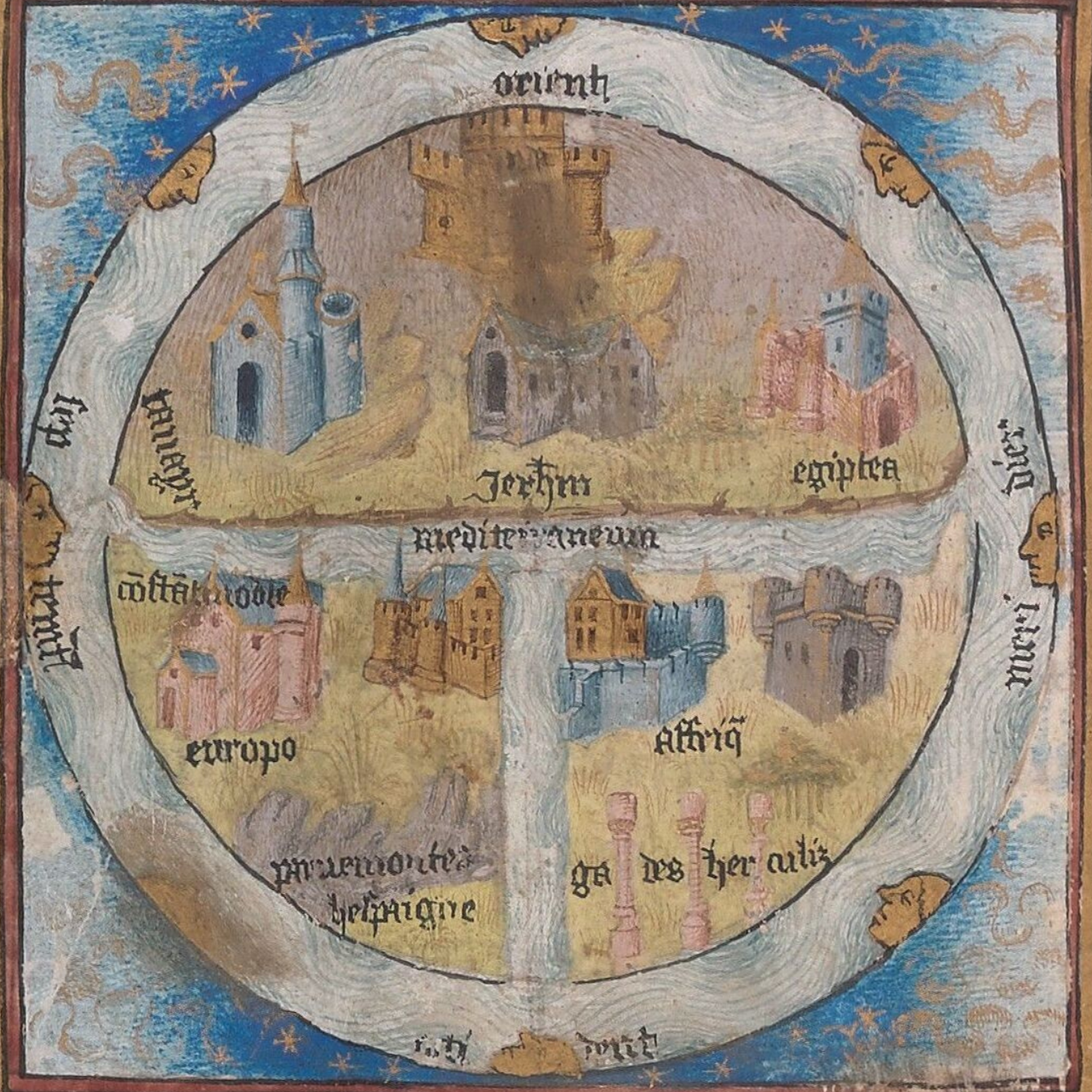
There is no doubt that the medieval Church believed in a spherical earth. Some modern scholars who thought medieval people believed in a flat earth were misguided by the high-stylized medieval maps known as T-O maps.[14] The image at the top of this article is one such map held in Yale University’s Beinecke Rare Book & Manuscript Library. The library’s website states, “Medieval Europeans were well aware that the earth was curved, and these maps often note that they are simply diagrams useful for instruction, but they do not reflect the actual shape of the world, which is an orb or sphere.”[15]
This medieval belief in a spherical earth was not just within the Church hierarchy or elites, but within the laity, and even among non-Christians. As Hutchings and Ungureanu point out, blockbuster medieval books such as Dante’s Divine Comedy (1320), John Mandeville’s Travels (c. 1360), and Chaucer’s Canterbury Tales (c. 1400) all treat the earth as a round, spherical object.[16] They actually assume it, and given the popularity of their books, it would seem others assumed it as well. That the earth was a sphere was universally understood and had been for a long time by this point.
As it turns out, the Church had just always believed what had been known since at least the fifth century BC: the earth is round. Hannam writes that
The Egyptians, Babylonians, and first Greek philosophers all assumed the earth was flat. However, by the fifth century BC, Greek astronomers had established that the earth was spherical, and the question ceased to be controversial among educated people shortly thereafter. This knowledge of a spherical earth has not been lost at any point since.[17]
Historian of Science Lesley B. Cormack explains that scholars in antiquity postulated spherical models of the earth for a variety of reasons: geographical, astronomical, philosophical, and mathematical. They observed the earth’s shadow on the moon and ships disappearing over the horizon. This group includes well-known ancient Greek figures such as Pythagoras (c. 570-c. 495 BC), Aristotle (384-322 BC), Euclid (C. 325-c. 270 BC), Eratosthenes (276-c. 194 BC), and Ptolemy (c. 100-170 AD), along with the most influential Roman commentators like Pliny the Elder (AD 23-79), Pomponius Mela (d. 45 AD), and Macrobius (c. 370-c. 430 AD). Of the early church fathers, the highly influential St. Augustine (AD 354-420), St. Jerome (d. 420), and St. Ambrose (d. 397) all believed in a spherical earth.[18] Origen of Alexandria (c. 185 – c. 253), who influenced all of the major early church Fathers and who would set the course for what Christian biblical interpretation looked like, also wrote explicitly of the sphere of the earth (On First Principles 2.3.6)
Of course, you could be right for the wrong reasons. Many people believed in a spherical earth, yes, thanks in large part to Aristotle who reasoned that a spherical universe required a spherical earth—at its center. Incredible as it may seem, according to the esteemed David Lindberg, Aristotle believed the earth was spherical because of the geocentric theory of the world wherein the sun revolves around the earth, which sits at the universe’s center, stationary (I discuss this in reference to Nicolaus Copernicus elsewhere).[19]
Before we ridicule Aristotle or the rest of the ancient world for where they did get the science wrong, we must remember that they were doing the best they could with the instruments available. The progress of science is often at the mercy of instrumentation. We should also in humility realize that the question is not settled on many or any scientific questions, and no doubt in a century our descendants will look back at our own time as one of scientific naïveté. This should also give every Christian pause who seeks to either reconcile the Bible with modern science or debunk modern science with the Bible, both of which being somewhat alien uses of Scripture that force it to play an ever-shifting game that may place unnecessary stress on the struggling believer.
This warning about the attempt to reconcile the Bible with contemporary science was also a well-known issue in the ancient church. As Peter C. Bouteneff relays in the context of the six days of creation, ancient Christian writers
emphasized that the Hexaemeron [six days] was not about science: it did not narrate God’s technology. Origen and especially the three Cappadocians were versed in the science and medicine of their day and enjoyed engaging it for its own sake, but not primarily to reconcile it with the scriptural account of creation, although, given the evolution of cosmology, they did periodically pause to consider, for example, the precise nature of the “firmament.” Their excursuses into science served only to amplify their sense of wonder at the intricacy of creation and the glory of God. More than anything else, all Christian commentators on the Hexaemeron were taken by what the creation told us about the Creator. … Providence, indeed, was central to the early fathers’ understanding of the Bible as a whole. Their identification of types in the OT—or, more broadly, their understanding of the OT in the light of Christ—testified to their conviction that God’s love for the world was expressed in a thorough, providential ordering of the world through history, though outside the constraints of chronological time.[20]
The Culprits: Lactantius and Cosmas
The proof for the history of flat earthism in Christianity largely comes down to two people. Lucky for us, Andrew Dickson White wrote about those two archnemeses of science, Lucius Caecilius Firmianus Lactantius (c. 250-c. 325) and Cosmas Indicopleustes (c. 6th century), in The History of the Warfare of Science with Theology in Christendom:
Some of the foremost men in the Church devoted themselves to buttressing [the flat earth model] with new texts and throwing about it new outworks of theological reasoning; the great body of the faithful considered it a direct gift from the Almighty.
Lactantius referred to the ideas of those studying astronomy as “bad and senseless,” and opposed the doctrine of the earth’s sphericity both from Scripture and reason.
[Cosmas’s flat earth doctrine] was accepted by the universal Church as a vast contribution to thought; for several centuries it was the orthodox doctrine, and various leaders in theology devoted themselves to developing and supplementing it.[21]
These are bold claims that fanned the flames seeking to burn down traditional church authorities and biblical literalists. But is it true?
Well, yes and no.
Yes, it is true that Lactantius and Cosmas took an overly literal and selective reading of the Bible to say that the earth was flat. Lactantius was known for his incredible learnedness and skill in rhetoric, but not his skill in biblical literacy or orthodox Christian theology. He apparently taught that Jesus and the devil were twins, that Jesus was an angelic creation of God, and that God had to create evil due to the laws of logic imposing themselves on Him.[22] He may have also denied the Personhood of the Holy Spirit, according to St. Jerome.[23] The Catholic Encyclopedia, which should adore Lactantius if the conflict thesis is correct, laments his “lack of grasp of Christian principles and his almost utter ignorance of Scripture.”[24] Cosmas likewise believed in a flat earth, largely because the Book of Hebrews’ description of heaven being a heavenly tabernacle and the earth its foundation, which he understood in a literal, physical sense.
That said, it is not true that either one of them had any influence in the Christian world, despite what later scholars who dusted off their manuscripts said. Lactantius’s work was largely unknown after his death and was not heard of again until his works gained interest as part of the fifteenth and sixteenth century Renaissance enthusiasm for classical authors. Lactantius was remembered by at least one Church Father, though. St. Jerome, who had massive influence in Latin Christianity, warned against Lactantius’s work, which was all sizzle and no steak: “Lactantius has a flow of eloquence worthy of Tully: would that he had been as ready to teach our doctrines as he was to pull down those of others!”[25]
Like Lactantius, Cosmas had no influence on the Church as a whole. Historian of science Pablo de Felipe notes that there were “no followers of Cosmas.”[26] Jeffrey Burton Russell, one of the scholars who helped reverse course on the scholarly consensus about medieval Christianity with his tellingly-titled Inventing the Flat Earth, wrote that “Cosmas’s blundered effort of the Middle Ages was virtually nil. … He had no influence on medieval western thought.”[27] Russell notes that Cosmas was condemned at the time by Christian philosopher John Philoponus (who apparently mocked him mercilessly), a contemporary of Cosmas, and his work only surfaced again in the ninth century when Patriarch Photius of Constantinople, a major Eastern bishop, also condemned it.
Hannam notes that there may have been others around Antioch who fell into the error of the flat earth[28], but it should be noted that while the Antiochene school is often viewed as the “hero” (within conservative Christian circles) in the alleged battle between their literal and the Alexandrians’ allegorical readings of Scripture (in truth, each school of thought used a mix of both), only a few ancient writers truly belonged to the hyper-literal, anti-allegorical school of interpretation in Antioch. Donald Fairbairn writes that these three are “Diodore [of Tarsus], Theodore [of Mopsuestia], and Nestorius. And, of course … all three of these were condemned by the church,” formally and informally, for heresy.[29]
Hutchings and Ungureanu offer a blunt conclusion to the Draper-White thesis:
So, in actual fact, the Church never believed in a flat Earth, never taught it, was never in need of correction on the matter—and the two poster boys of the Conflict and Warfare grand narrative, Lactantius and Cosmas, were written off by Christendom as weirdoes who were barking up entirely the wrong tree. Draper and White, then, weren’t just slightly off course—they were on a different planet altogether.[30]
To put a fine point on it, Lindberg declares, the medieval world of the alleged “Dark Ages” did not include a few people of note who believed in a flat earth. Rather, Cosmas was “the only medieval European known to have defended a flat earth cosmology …” The claim that this was a widespread view, let alone a majority view, “is totally false.”[31]
The Heart and Meaning of Flat Earth Texts
Within the longer tradition of Christian hermeneutics is the notion that most texts from the Bible are in some way expressing God’s relationship to the world and/or to human beings specifically. These texts are revealing something about how things should be in the midst of how things are. By the time the author of Genesis, traditionally understood to be Moses, had penned the story of the paradise of Eden, he was well aware that we were now blocked from that paradise. Who would understand that loss more than Moses, the one who had led the enslaves Israelites out of Egypt and into the desert odyssey? And so, Scripture is meant to instill in us a longing for restoration, to that intimate union with God once had that, now gone, is tangibly missing like a phantom limb. Like in the Song of Solomon (or Song of Songs if you prefer), stepping into the Scriptures is an exercise in being wounded by love (2:5; cf. 4:9, 5:7-8), both touched and longing to be touched again by His presence.
I do not doubt that God could provide these spiritual meanings and scientific truths in the same sentence, and perhaps often did just that in how He ordered the Scriptures. And some may find my forthcoming interpretations, in the spirit of the early Christians (see below for an addendum on early Christian interpretation of creation texts) focusing more on the spiritual rather than scientific, rather speculative. However, the why question is more the point rather than the how, and therefore, the how interpretations are the more speculative of the two, seeing as how they answer questions that may be foreign to the text about scientific truths that may be far from settled.
So, when we look at flat earth texts, they tell us something more than how God physically created the world, though they may also tell us that. And, in the traditional understanding of the Bible, which mimics the New Testament’s use of the Old Testament (which was a mix of allegorical, typological, and ‘literal’ interpretation), the Bible is more concerned with the why question of meaning and purpose rather than the how question of technical, scientific precision.
These texts tell us in idiomatic ways that God created the world in an orderly way, with a firmament, in preparation of fruitfulness and flourishing (Gen. 1:6-8), which is what he wants for us. The firmament holds the sun, moon, and stars, thus ordering our days, our festivals, and our rest (Gen. 1:14-18), as a way of reminding us to be together in communion with God and our neighbors. God is a master craftsman (Job 37:18) and deserves our honor and devotion, and yes, even our fear of him (properly understood). Since the earth is God’s footstool, and heaven his throne (Isa. 66:1), it means he reigns as our King. Eden itself was set up as a cosmic temple where heaven met earth, and still our worship spaces are but shadows of the heavenly temple and eternal liturgy there (Hebrews 8:2-5). Indeed, the heavens are stretched like a tent and the earth its (flat) foundation (Psalm 104:2-5), that is, heaven and earth together constitute an immovable tabernacle, a cosmic temple, the dwelling place where God approaches humanity just as the father approached his prodigal son (Luke 15:11-32).
The point is this: God created a paradise for us to dwell with Him forever. It is His heart’s desire, and should be ours, as well. As soon as we lost it, He began rebuilding it. The whole story of the Bible is God’s restoration of all things for the sake of our reunification and resurrection from death unto eternal life where God will abide in us, and us in Him.
What the Evidence Shows
Jeffrey Burton Russell stated bluntly that there were “at least two and at most five” early Christian fathers who denied a spherical earth. “On the other side,” he continues, “tens of thousands of Christian theologians, poets, artists, and scientists took the spherical view throughout the early, medieval, and modern church. The point is that no educated person believed otherwise.”[32] Stated differently, the number of Christians who held to a flat earth is statistically insignificant.
The world knew as early as the fifth-century BC that the earth is round. Ancient Christians knew it. Medieval Christians knew it. Some who interpreted the Bible in a rigid way foreign to the hermeneutical traditions of the Church got it wrong and, thankfully, had no followers to pass along their teachings. But to take this few, who were not influential, and to say that all of medieval Christendom, all of the early Church, or the Bible itself teaches a flat earth is an unfair and inaccurate argument to make.
In the end, we see this myth for what it is: merely intra-Christian polemics that culminated in the fabricated nineteenth-century “conflict thesis,” which then just morphed into the twentieth-century Fundamentalist-Modernist controversy in which it was finally settled, once and for all: Christianity and science are at fundamental odds. But, of course, that wasn’t and isn’t true. A brief glance at the faith commitments of major scientists of the past and present should be enough to dispel us of the notion of conflict. It now persists as a quest to rewrite history in order to undermine trust in the Bible and associate all of Christianity with anti-scientific ignorance.
In a world where religious authorities, and even adherents, were dwindling, some mostly well-meaning people tried to save Christianity from its past and prove to the world that Christianity was quite “modern.” At that time, to call Catholics flat-earthers was to call them anti-modern, as the link between the two had become quite strong in the nineteenth century. And to be anti-modern was just about the worst thing you could be! Cormack explains that “in the nineteenth century, scholars interested in promoting a new scientific and rational view of the world claimed that ancient Greeks and Romans had understood that the world was round, but that this knowledge was suppressed by medieval churchmen.”[33] Some Catholic scholars attempted to rebut the claims with facts, but the cultural winds were too strong.
Hoping to be part of this new rebuilding of civilization based on ancient classics, some Protestant Christians attempted to rehabilitate Christianity as a religion either pristine in its Primitive state or always evolving yet darkened by the formation of the Catholic Church/church tradition (by which they tend to mean post-Constantine Christianity, though sometimes these nineteenth-century scholars, such as Adolf von Harnack, also spoke of the alleged Hellenization thesis as the point of divergence from purity). This birthed the historical biblical criticism of the Bible in which the Scriptures became things to be dissected rather than God’s Word to be adored and followed and, most importantly, understood in its traditional sense.[34] This criticism was meant to save Christianity, but it has undermined it beyond measure. So, too, has the conflict thesis.
One thing we can learn about the crisis of the flat earth is that sometimes, when we think we know how to “fix” Christianity to make it more relevant to the world, perhaps we should instead take the lessons of the Bible to heart and allow the Holy Spirit to fix us instead. Like Elihu said to Job, “Can you join [God] in spreading out the skies, hard as a mirror of cast bronze?” (37:18). Tend to the garden God has asked you to. Remember who you are and who He is. See His love and care for you and wonder in the mysterious magnitude of it all. This vision was the point all along.
Optional Addendum: How the Ancient Church Handled Genesis and Other “Science” Texts
You may be wondering: Why should I care what the ancient church said? I only care about what the Bible says! Fair enough. However, sometimes our best bet for understanding what the Bible actually meant and how the Apostles understood and taught its meaning is to look at the reception history in the early church.
What we sometimes don’t realize is that a lot of the methods we use to interpret the Bible today come from scholars who were not faithful Christ-followers themselves! Their way of interpretation was to apply a “hermeneutic of suspicion” to the text through imposing alien, anachronistic methods. To be sure, these have sometimes allowed for us to understand things about the text that we did not know before, but it has also led to scholars proposing things like Christ is nowhere to be found in the Old Testament, which of course disagrees with much of the New Testament.
Furthermore, this allegedly “scientific” dissection of the Bible that takes place in historical biblical criticism and all of the criticisms that arose after it has done very little to settle the matter on what any particular text means. Rather, we tend to get dissertations that not-so-coincidentally agree with the scholar’s own foibles and idiosyncrasies. And this is a lesson for all of us: often when we think we are merely reading the text plainly and understanding its meaning without a tradition, we are unwittingly subject to the lenses provided by unseen traditions (invisible scholars, the interpretation of your preferred translations, our own cultural dogmas or taboos, family history, biology, etc.). It is the Enlightenment, after all, that “launched the tradition of living without a tradition,”[35] which merely blinded us to the traditions that inform us by convincing us what pops into our head is our own invention.
David Paul Parris explains that “every act of understanding takes place within the constraints of our customs, language, and tradition, and invokes possible projections for understanding.”[36] And so, it stands to reason that we might want to get as close as we can to the people whose customs, languages, and traditions were closer to those of the authors of Scripture. To automatically assume we know better than them because of the forward march of modern scholarship is merely C. S. Lewis’s famous description of chronological snobbery: “The uncritical acceptance of the intellectual climate of our own age and the assumption that whatever has gone out of date is on that count discredited.” The ancient Christians had access to people and texts we could only dream about having today.
This chronological snobbery and anti-traditionalism is, once again, the infiltration of Christianity by the legacy of the Enlightenment’s doctrine of tradition that assumed “it was not a trustworthy source of knowledge,” no doubt related to the Enlightenment’s proto-Critical Theory stance about a “mutually exclusive antithesis between authority and reason.”[37] Rather, Parris states, there is good reason to accept some traditions: “The acceptance of the authority of tradition is not blind obedience but the acknowledgement that those who precede us may have had better insights and judgments than we do.”[38] He adds that we are not passive receivers of tradition but active participants in dialogue with it.[39]
Also, not only might we learn what the early Christians thought about the texts, but also the emphasis they put on them. (This we already discussed in part when we looked at the difference between the how and why of the creation narratives in Genesis.) This can be instructive to us on how to embrace an authentically Christian way of viewing, to borrow a Roman Catholic term, the “deposit of faith” of the Bible and faithful tradition concerning the Bible.
And so, it might be helpful to think about how the early Church viewed the book of Genesis and other creation texts by considering how it understood the “six days” of creation. In Since the Beginning: Interpreting Genesis 1 and 2 Through the Ages, multiple experts discuss this very issue with surprising conclusions.
To summarize the overall findings of the book—which surveys Second Temple Judaism, Rabbinic Judaism, the Ante-Nicene, Nicene, and Post-Nicene Fathers, and medieval Jewish and Christian interpreters—we can say that some ancient and medieval voices did believe the Bible was six literal days, but not all. Some disagreed because contemporary science and philosophy had, they thought, made that view untenable (yes, even ancient science threw doubt on these matters). But some also disagreed because of textual discrepancies and simply looking at the genre being used and attempting to understand how God communicates with people who have a limited capability to understand such complicated matters at the time. This latter group, who understood God as accommodating his revelation to the understanding of His people, was aware that the masses often took the Genesis text at face value, but they did not feel the text demanded it. Rather, they looked at the larger story and movement of Scripture and tried to focus on what they saw was the main essence of the Scriptures as the revelation of God through His people, to His people, for His people.
Even those ancients who may have assumed the six days of creation literally—and after all, they had little reason to doubt it—also understood the days symbolically, as if the symbolism was the more important part of the text. St. Irenaeus of Lyons and Origen of Alexandria both noted the different ways in which “day” was used in Genesis.[40] Origen, who despite later controversies (which may have been more about his followers than himself) was a beloved and meticulous Bible interpreter as mentioned above, wondered how anyone could count the number of days before the creation of the sun and moon, writing, “no one, I reckon, really doubts that these things are related by Scripture figuratively, so that certain mystical truths are indicated through them.”[41] This type of interpretation was a very Christian mode of interpretation, found in the Scriptures themselves, akin to the way of viewing the Scriptures of Israel as pointing to Christ—literalists in Israel missed it, but those with the eyes of faith were granted true vision of the Scriptures through the Holy Spirit (2 Cor. 3:15-18).
Intriguingly, in the Nicene and Post-Nicene Fathers, the focus was often on the days of creation, but the purpose of that focus was different. They wondered not whether the days were literal or figurative but why on earth God chose to create in time at all! God could have created everything instantaneously, after all. St. John Chrysostom (c. 347-407 AD) said God created within time so that people would know they were not created by chance without a divine being or purpose. St. Ambrose argued similarly to refute Plato’s pupils (who believed the fundamental principles are uncreated, incorruptible, and beginningless) and Aristotle (who taught that the world/universe was eternal). The debate was often not over whether the term “day” was a literal 24-hour period, but rather, whether the “day” indicated any period of time, or if it described an event that was timeless. St. Augustine believed that God made all things at once and not over intervals of time, as suggested by Genesis 1:1. He was not all that clear on how to interpret the days of Genesis.[42]
Essentially, the way the early Christians seemed to view these texts is the way modern scholars have discovered the texts were meant to function: as theological history (which I have written about elsewhere). It is not that they are untrue. No, they are all based on real events—God did create everything, there really was a catastrophic flood, and so on—but those real events are told in ways that, you guessed it, explain the meaning of the event and are not necessarily designed to explain to you what you would have seen had you been there recording the events with your iPhone. We are used to this type of history telling even today. For instance, the first shot fired in Concord, Massachusetts—sparking the beginning of the American Revolutionary War—was not literally “the shot heard round the world.” Nonetheless, you get the point when it is labeled as such. Moreover, in theological history, these stories in Genesis are told polemically, reacting to and correcting the distorted yet similar stories told by other Mesopotamian peoples. These were texts not merely of creation, but of spiritual warfare.
There were other views as to the days of Genesis in the ancient Church as well, as there often are when your most important consideration is the pastoral implications of each text (i.e., when there is vast agreement on what the text meant and multiple applications on what the text continues to mean for the life of the faithful). But there was no dogmatic conclusion other than, “We believe in one God, Father Almighty, maker of heaven and earth and of all things visible and invisible. And in one Lord, Jesus Christ … through whom all things were made,” which comes from the foundational and Christian-identity-defining Nicene Creed, based on Paul’s language in 1 Cor. 8:6. Peter Bouteneff summarizes their understanding well: “Providence, indeed, was central to the early fathers’ understanding of the Bible as a whole. Their identification of types in the OT—or, more broadly, their understanding of the OT in the light of Christ—testified to their conviction that God’s love for the world was expressed in a thorough, providential ordering of the world through history, though outside the constraints of chronological time.”[43]
Whatever they made of the texts, they were not viewing them “scientifically,” in how we mean that term today. As Bouteneff explains, the ancient Christians, specifically those highly influential Cappadocians and Origen who were very conversant with their own day’s understanding of science and medicine and would lay the groundwork for the Christian hermeneutical tradition, believed that Genesis “did not narrate God’s technology.”[44] Our own obsession with reconciling the texts of Genesis with modern science is a relatively recent phenomenon with elements of it growing out of the early modern period but going into overdrive during the Fundamentalist-Modernist controversy. That is not to say it is illegitimate to ponder these questions at all; it is just to say that forcing an agreement between the two may be misunderstanding the purpose of Scripture in the relevant sections. See footnote 18 for more discussion and resources on this topic.
The concern is not just about whether we have understood Scripture correctly enough to engage in this endeavor, but also whether we know enough about the study of the natural world to make any bold declarations. St. Augustine had this fear during his own day, noting that the Bible already conflicted with the best Greek science. Augustine was concerned that Christians, knowing a lot of the Bible and little about science, would attempt to reconcile the two and thus make Christianity look ridiculous.[45] It seems like his concern was mostly about taking the Bible in a woodenly literal sense.
But there is another concern: taking current science too authoritatively. I have no doubt that much of what we have learned in science is true. But imagine that the early Christians were successful in reconciling the Scriptures with ancient Greek science: where would we be now that much of ancient Greek science has been overturned? Perhaps we would be fine and chalk it up to fallible religious zeal, but we would also see that it was a futile exercise. And perhaps much of that could be the same now, for those who might wish to reconcile the Bible with the Big Bang or the multiverse, or with evolution or quantum physics, whatever the case. Some of modern science makes the Bible look good, and some seems to contradict the Bible. What if we convince the world that, yes, the Bible teaches a multiverse, and we point out that Origen predicted this centuries ago![46] … but then find in a century ot two that the multiverse is impossible? So, it is my opinion (which is not infallible) that when speculating about technical processes God did not explain to us exhaustively, we hold these conclusions loosely, with the understanding that we see through a glass darkly.
[1] It should be noted that there are actual “flat earthers” out there who approvingly claim that the Bible does indeed teach a flat earth and that this truth has been hidden in order to undermine biblical authority among other nefarious things, all having to do with the demonic quest for power. But the “flat earther” phenomenon is a modern, anti-establishment phenomenon that apparently began in earnest with the work of British inventor Samuel Birley Rowbotham (1816-1884) in the mid-nineteenth century. The flat earth hypothesis experienced something of a revival with the rise of social media and YouTube due to a number of sociocultural factors. Nevertheless, even if growing, it remains a minority view. The modern phenomenon of flat earthers is a separate issue that tends to have more to do with reactionary politics than with the other issues that we will address here.
[2] The final two texts from the Gospels are said to posit a flat earth since it depicts a sudden event impacting people who are in bed, presumably sleeping at night, and people who are working, presumably during the day. The notion that it would be night for some people while at the same time it is daytime for others leads some to believe that this text presupposes a round earth where people experience different time zones.
[3] James Hannam, God’s Philosophers: How the Medieval World Laid the Foundations of Modern Science (London: Icon Books, 2017), 3.
[4] Hannam, God’s Philosophers, 35.
[5] James Hannam, “Flat Earth,” in Copan, Longman, Reese, and Strauss (eds.), Dictionary of Christianity and Science (Grand Rapids, MI: Zondervan, 2017), 285.
[6] Hannam, “Flat Earth,” 285.
[7] Hannam, God’s Philosophers, 10.
[8] “Progressive” here being understood for what it was in its time—against dogmatism, authortarianism/hierarchicalism, and anti-modern theology—rather than what would pass for progressive Christianity today.
[9] Peter Harrison, Some New World: Myths of Supernatural Belief in a Secular Age (Cambridge: Cambridge University Press, 2024), 220-233.
[10] David Hutchings and James C. Ungureanu, Of Popes & Unicorns: Science, Christianity, and How the Conflict Thesis Fooled the World (New York: Oxford University Press, 2022), 53-54.
[11] Ronald L. Numbers, ed., Galileo Goes to Jail and Other Myths About Science and Religion (Cambridge, MA: Harvard University Press, 2009), 1, 6. Quoted in this form in Hutchings and Ungureanu, 15.
[12] Hannam, God’s Philosophers, 4.
[13] Hannam, God’s Philosophers, 4.
[14] Hannam, Dictionary of Christianity and Science, 285.
[15] Raymond Clemens, “Medieval World Maps (T-O Maps),” Beinecke Rare Book & Manuscript Library,” July 11, 2022, https://beinecke.library.yale.edu/article/medieval-world-maps-t-o-maps.
[16] Hutchings and Ungureanu, 63.
[17] Hannam, ”Flat Earth,” 284-85.
[18] Lesley B. Cormack, ”That Medieval Christians Taught That the Earth Was Flat,” in Ronald L. Numbers (ed.), Galileo Goes to Jail: And Other Myths About Science and Religion (Cambridge, MA: Harvard University Press, 2009), 30-31. See St. Augustine of Hippo, City of God 16.9; St. Jerome, Commentary on Ephesians, on Ephesians 3:18; St. Ambrose of Milan, Hexameron 2.3.8-9
[19] David Lindberg, The Beginnings of Western Science: The European Scientific Tradition in Philosophical, Religious, and Institutional Context, Prehistory to A.D. 1450, 2nd ed.(Chicago: The University of Chicago Press, 2007), 55-56.
[20] Peter C. Bouteneff, Beginnings: Ancient Christian Readings of the Biblical Creation Narratives (Grand Rapids, MI: Baker Academic, 2008), 170-71. This does not mean that there can be no historical scientific truth found in the Genesis account. Indeed, many look to it as the first attestation to Big Bang cosmology and the understanding of immaterial information, such as in the work of astrophysicist Hugh Ross. Rather, the point is that the main concern of the text—what Yahweh wants His people to know about Him—is who He truly is and who they truly are, not the intricate details of creating and organizing matter. For instance, Old Testament scholar and pastor Michael Lefebvre has made the case that, rather than having to understand the creation days of Genesis as six literal days, we can understand the creation week narrative as “contain[ing] the history of God’s ordering of the world, mapped to Israel’s observance schedule for stewarding that order with labor and worship, without any concern to preserve the events’ original occurrence timing.” Michael Lefebvre, The Liturgy of Creation: Understanding Calendars in Old Testament Context (Downers Grove, IL: IVP Academic, 2019), 117. In other words, God’s creative acts are explained in a way that would have made sense to this agricultural society: creating the space for fruitfulness, populating that space for flourishing and blessing, and a day of rest for worship and thankfulness. Indeed, as Lefebvre continues, “The Torah adapts historical narratives to the dates of festival calendars for the sake of observance, not chronology. The creation week is another narrative ascribed with observance dates that do not preserve the original occurrence timeline” (Lefebvre, 138). Another option given is one by Old Testament scholar John Walton, who believes that the creation narrative is actually a “cosmic temple inauguration,” in which God is establishing the earth as His temple. See John Walton, The Lost World of Genesis One (Downers Grove, IL: IVP Academic, 2017). Conversely, Hans Madueme makes a fair point when he says that Christians do not need to let go of a literal, “young earth” view of creation simply because science finds it untenable. Christians believe in many things science cannot explain. See Hans Madueme, “All Truth is God’s Truth: A Defense of Dogmatic Creationism” in Gerald Hiestand and Todd Wilson (eds.), Creation and Doxology: The Beginning and End of God’s Good World (Downers Grove, IL: IVP Academic, 2018). As a matter of fact, some of our most inflexible beliefs fly in the face of scientific knowledge—such as a virgin birth—and natural law—such as resurrection, which appears to break the 2nd law of thermodynamics relating to entropy. That said, we shouldn’t consider the work of Lefebvre, Walton, and others as attempting to make the Bible palatable to a secular, scientific worldview. That may be an outcome, and may be something they find their work aiding, and it may have even been the catalyst for their inquiries, but they are ultimately seeking to understand the Old Testament text in and on its own terms. And they are not the first ones: long before the world was introduced to scientific theories of evolution, Big Bang cosmology, and a universe billions of years old, Christians in all eras (most famously, Augustine) were trying to understand the biblical text on its own terms and were finding non-literal interpretations of the creation narrative to be the correct readings. See Craig D. Allert, Early Christian Readings of Genesis One (Downers Grove, IL: IVP Academic, 2018); Kyle R. Greenwood, Since the Beginning: Interpreting Genesis 1 and 2 Through the Ages (Grand Rapids, MI: Baker Academic, 2018); Peter C. Bouteneff, Beginnings: Ancient Christian Readings of the Biblical Creation Narratives (Grand Rapids, MI: Baker Academic, 2008). This is not to say that there were not proponents of a literal six-day creation week, but rather just to say that it was far from a settled question long before the modern “creationism” debates since Darwin.
[21] Andrew Dickson White, A History of the Warfare of Science with Theology in Christendom, 2 vols. (New York: D. Appleton and Co., 1896), 1:95, 1:92, 1:326. Pages 95 and 326 are quoted in Hutchings and Ungureanu, 55.
[22] Hutchings and Ungureanu, 66.
[23] See St. Jerome’s Letter 84 to Pammachius and Oceanus at https://www.newadvent.org/fathers/3001084.htm.
[24] Cited in Hutchings and Ungureanu, 66. The Catholic Encyclopedia entry can be found at https://www.newadvent.org/cathen/08736a.htm.
[25] Hutchings and Ungureanu, 66. They note that the original source is Jerome‘s Letter LVIII to Paulinus, paragraph 10.
[26] Quoted in Hutchings and Ungureanu, 67. Original source Pablo de Felipe and Robert D. Keay, ”Science and Faith Issues in Ancient and Medieval Christianity.” BioLogos, December 2, 2013, https://biologos.org/articles/science-and-faith-issues-in-ancient-and-medieval-christianity.
[27] Quoted in Hutchings and Ungureanu, 67. In Jeffrey Burton Russell, Inventing the Flat Earth: Columbus and Modern Historians (Westport, CT: Praeger, 1991), 34-35.
[28] Hannam, ”Flat Earth,” 285.
[29] Donald Fairbairn, “Patristic Exegesis and Theology: The Cart and the Horse,” Westminster Theological Journal 69, no. 1 (Spring 2007): 14-15.
[30] Hutchings and Ungureanu, 68.
[31] Lindberg, 161.
[32] Hutchings and Ungureanu, 62. Quoting Russell, “The Myth of the Flat Earth,“ https://www.asa3.org/ASA/topics/history/1997Russell.html.
[33] Cormack, 29.
[34] See Michael C. Legaspi, The Death of Scripture and the Rise of Biblical Studies, Oxford Studies in Historical Theology(Oxford: Oxford University Press, 2010); Scott W. Hahn and Jeffrey L. Morrow, Modern Biblical Criticism: As a Tool of Statecraft (1700-1900) (Steubenville, OH: Emmaus Academic, 2020);Jonathan Sheehan, Enlightenment Bible: Translation, Scholarship, Culture (Princeton, NJ: Princeton University Press, 2005).
[35] Roger Lundin, ”Interpreting the Orphans,” in The Promise of Hermeneutics (Grand Rapids, MI: Eerdmans, 1999), 3. Quoted in David Paul Parris, Reception Theory and Biblical Hermeneutics, Princeton Theological Monograph Series 107(Eugene, OR: Pickwick Publications, 2009), 3.
[36] Parris, 4.
[37] Parris, 6, 8.
[38] Parris, 8.
[39] Parris, 10.
[40] Stephen O. Presley, “Interpretations of Genesis 1-2 among the Ante-Nicene Fathers,” in Kyle R. Greenwood (ed.), Since the Beginning: Interpreting Genesis 1 and 2 through the Ages (Grand Rapids, MI: Baker Academic, 2018), 97-120.
[41] Origen, On First Principles 4.3.1, Latin version, trans. John Behr (Oxford: Oxford University Press, 2019), 263. This whole section on The World is fascinating, referring to all of the “spheres” in the cosmos, including the earth, and “the other celestial bodies, which they call planetas” which meant “wanderers.” That said, some creationists have answered Origen’s challenge, and the reader can decide if they have been successful.
[42] C. Rebecca Rine, “Interpretations of Genesis 1-2 among the Nicene and Post-Nicene Fathers,” in Greenwood, 121-145.
[43] Bouteneff, 171.
[44] Bouteneff, 170.
[45] Hannam, God’s Philosophers, 314-15.
[46] On First Principles 2.3.4.