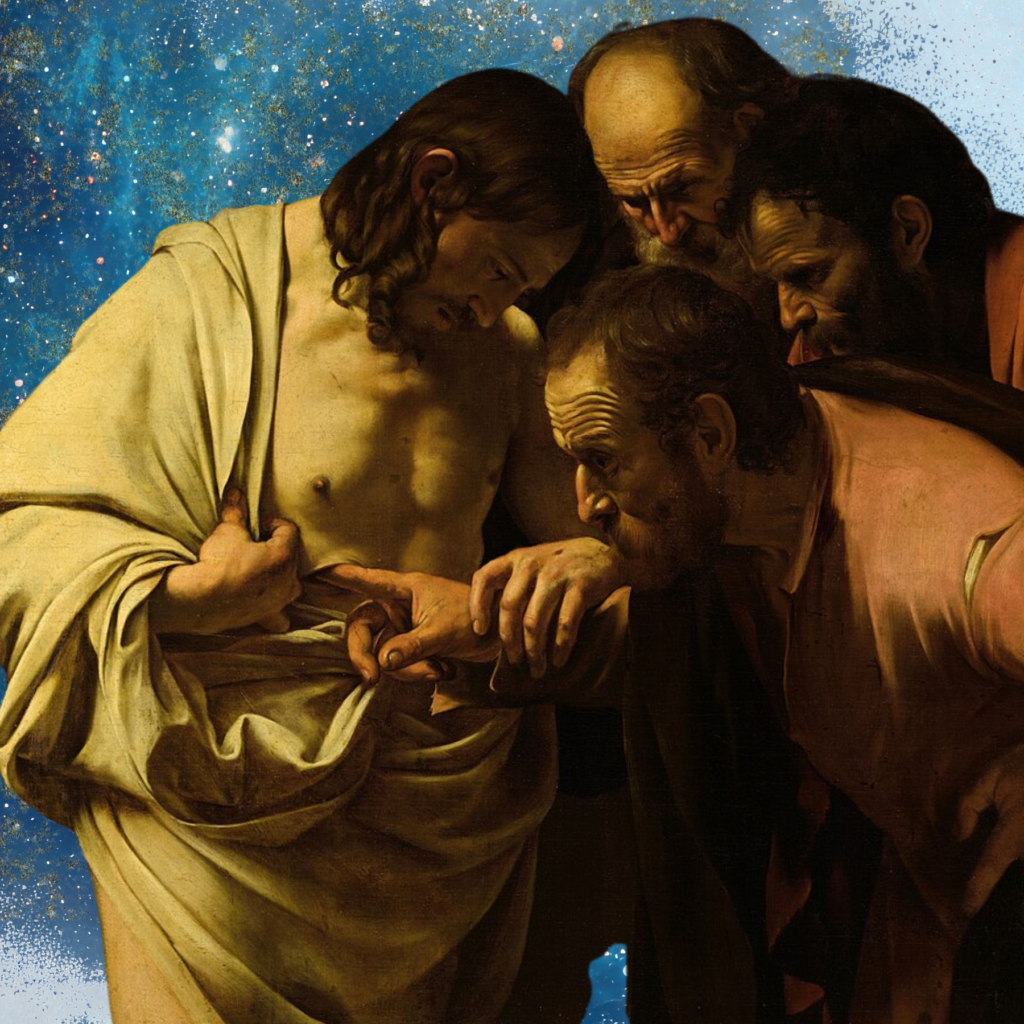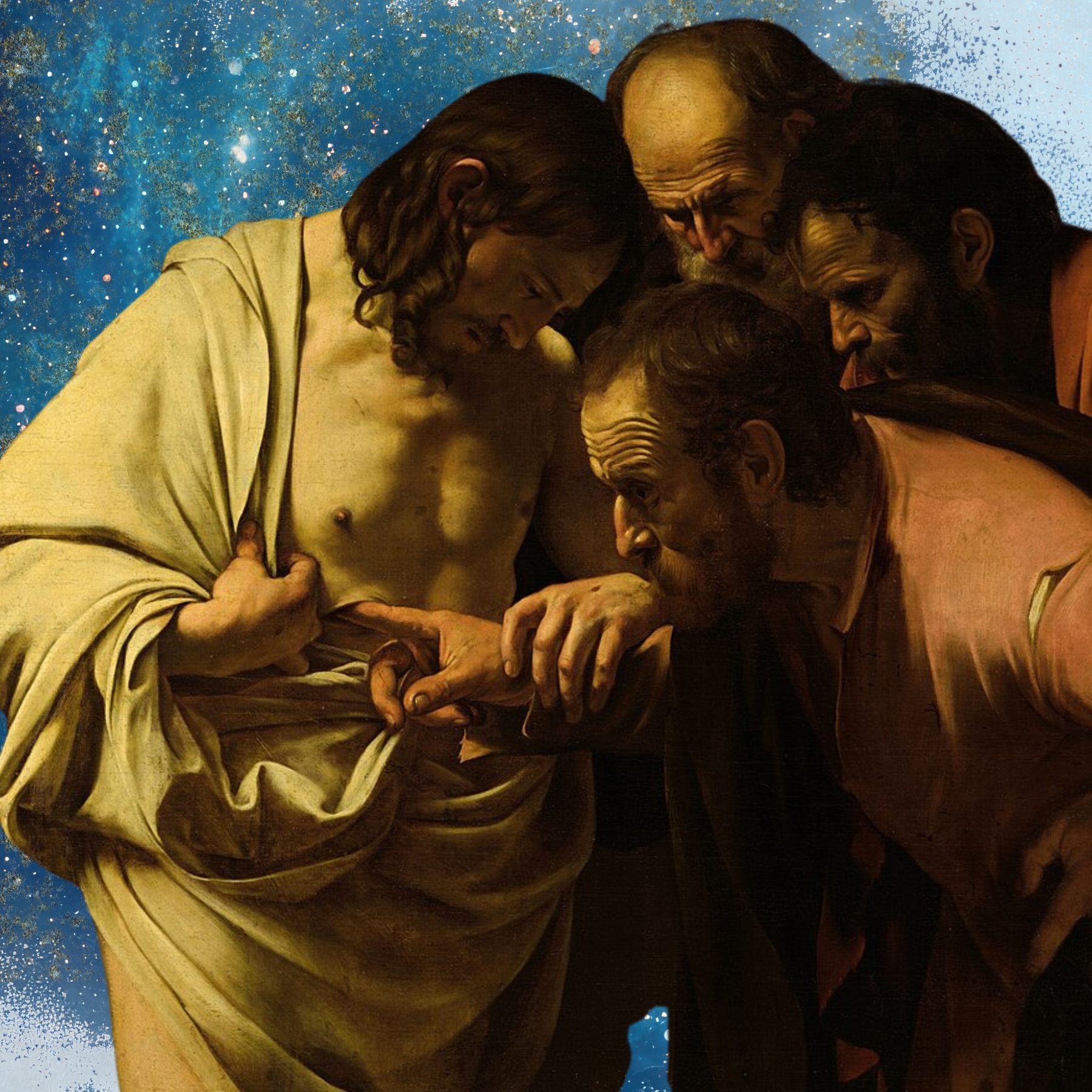

Then he said to Thomas, “Put your finger here; see my hands. Reach out your hand and put it into my side. Stop doubting and believe.”
John 20:27
A friend recently asked me about the significance of Christ’s wounds appearing post-resurrection. He was quite struck and deeply moved by the image, but didn’t quite have the words to express it. I’m not sure I do either. Nevertheless, here we go.
It can seem like quite an odd thing at first. Christ’s resurrection body, the firstfruits of our own resurrection, still has scars in it. Most people instinctively ask: does that mean I’ll have my scars too? They ask this with trepidation, for it is their very scars (whether physical, emotional, or psychological) that they are hoping to be rid of in the world to come. They were hoping their glorified bodies would be perfected bodies.
There are certainly things I would like to be changed about myself. While my mother might think I’m close to perfect, I know myself all too well to let the lenses of love blind me. I believe and confess, Lord, that You are truly the Christ, the Son of the living God, Who came into the world to save sinners, of whom I am the first.
While the question of my own scars used to haunt me, I think the more interesting question remains about Jesus himself. Why might his body still bear the scars of his crucifixion? Because it has become an integral part of who Jesus is, a physical symbol of his incarnate life and divine identity. While it is clearly true—as told in the Gospel of John (John 20:28) and the majority of the Church’s theologians—that one major reason Christ kept his scars was to prove to his disciples that he had truly died and been resurrected in the flesh, I believe there is more to the story.
Seek and You Shall Find
We are promised to find Christ when we seek him (Matt. 7:7-8). And yet, false Christs will come and deceive, if possible, even the elect (Matt. 24:24). In ancient Christian monastic literature, this is a major theme. Demons are always appearing to those praying in the desert as angels or as Christ himself. Because these desert ascetical monks have ostensibly given up all desire for material possessions or worldly power, demons are sometimes said to appear to them in powerful visible manifestations since they cannot tempt them with the usual temptations of sex, power, money, and/or fame.
One such story centers around the figure of Martin of Tours, a fourth-century monastic and Bishop known for exceptional acts of charity. To give some insight into how beloved he is, he is venerated as a Saint in Catholic, Eastern Orthodox, Oriental Orthodox, Anglican, and Lutheran churches.
There is told one story in the hagiography of St. Martin by chronicler Sulpicious Severus (AD c. 363-c. 425). One day as Martin was deep in prayer, the devil came to him surrounded by purple light, clothed in a royal robe, with an ostentatious jewel-encrusted golden crown on his head. His shoes were also golden. His demeanor was calm and his face full of tranquil joy. The devil was presenting himself as the enthroned Christ. He had pulled this trick before and had fooled many into following him.
Martin just kept his silence in prayer, however. The devil eventually broke the silence, saying, “Acknowledge, Martin, who it is that you behold. I am Christ; and being just about to descend to earth, I wished to first manifest myself to you.” Martin remained silent. The devil doubled down: “Martin, why do you hesitate to believe, when you see? I am Christ.”
But the Spirit had revealed the truth to prayerful Martin, and so he finally replied: “The Lord Jesus did not predict that he would come clothed in purple, and with a glittering crown upon his head. I will not believe that Christ has come, unless he appears with that appearance and form in which he suffered, and openly displaying the marks of his wounds upon the cross.” Hearing these words, the devil vanished like smoke, leaving behind a putrid stench.
Did you catch the main difference between the devil and Christ? This was a common notion in the lives of these early desert fathers. One of their ancient sayings goes, “The devil can imitate everything. As for fasting, he never ate; as for watching, he never slept. But humble-mindedness and love he cannot imitate. So let there be a great effort on our part to have love within us and hate pride, through which the devil fell out of heaven.”[1] The devil fell through pride; Christ was exalted through humility. Christ ascended with his wounds intact, yet the devil could not bring himself to even pretend to have wounds on his body.
Christ keeps his wounds so that we might recognize him and know him as our Lord who lived in humility just as we should. Thomas knows him by touching his wounds (John 20:24-28). Paul tells us to be like him, emptying ourselves (Phil. 2:5-8). And this is how we will know him from his counterfeits, which have all had one glaring similarity amongst them: the devil’s pride.
Only the Suffering God Can Help
In the midst of Dietrich Bonhoeffer’s own suffering in the mid-1940s, when one might have expected him to pray to the God of the Canaanite conquest to destroy his enemies and set the wicked world aright, the German theologian instead tells us that “only the suffering God can help.”[2] It is the necessity of what Flannery O’Connor called the “bleeding stinking mad shadow of Jesus” which haunts this demon-haunted world that said world so desperately needs. And, Bonhoeffer tells us, this is the only God we have. We have finally been forced to confront the true God.
Bonhoeffer tells us this in a rather confusing letter he wrote from prison that has baffled, and at times misled, theologians for decades. Some even used it to say that Bonhoeffer was a “Death of God” theologian, which is quite the opposite of what he means to relay. If anything, people accustomed to a certain idea of God—which may have led them to accept a certain idea of political leader—would be face to face with the living God for the first time. In defense of those theologians who took these words and made a Bonhoeffer in their own image, it should be said that the words are indeed cryptic, and Bonhoeffer did not live long enough to expound upon them for us. Bonhoeffer was executed by hanging on April 9, 1945, at the Nazi’s Flossenbürg concentration camp in Bavaria, Germany.
It is worth listening to Bonhoeffer’s words to truly understand what it is he is trying to say (all readers would benefit from going through the letters in full for themselves): “As a working hypothesis for morality, politics, and the natural sciences, God has been overcome and done away with, but also as a working hypothesis for philosophy and religion …,” Bonhoeffer writes.[3] God is not the end of an argument, but rather, the ground of all Being. He is not to be plugged into the gaps of our ignorance but understood as the One who delights in our discovery of his creation.
There is no going back to a simpler, sacrosanct time, before the scientific revolution, before the Enlightenment, etc. It has happened, as Peter Harrison has written about in his magisterial Some New World. “The changing content, status, and background assumptions of the proofs for God’s existence in the modern period are revealing,” Harrison explains. “It is clear from the sixteenth century onwards the existence of God moved from being something that could be more-or-less taken for granted, to something for which supportive arguments needed to be provided. The burden of proof thus gradually shifted from largely imaginary atheists to defenders of theism. … [T]he deist philosopher Anthony Collins mischievously suggested that no one thought to question the existence of God until the Boyle Lecturers set out to prove it …”[4]
God was exposed to the rules of logic and, sadly, the logicians, rhetoricians, critical scholars, etc. found the hypothesis of God weak and wanting. It’s not that ‘the God hypothesis’ is actually weak or wanting, but that turning God into an object of philosophical speculation—turning him into a hypothesis at all—fundamentally changed the approach to, and understanding of, God.[5] It allowed finite minds to judge the Infinite. It was a Pandora’s Box moment that cannot be forced back into the container. Even strong arguments will appear weak by the very fact that the arguments exist. Not that exposing the weakness of an argument is not the same thing as denying the reality of God, but within the hubris of homo sapiens mind, it became the same thing. For, to us, to self-consciously think we “understand” a thing is to insidiously believe at a sub-rational level that the thing is under our dominion. This is the mind of fallen humanity, which always seeks to place God in a box before tossing said box into the rubbish heap.
In other words, the problem was with the approach Abdu Murray often laments: to speak of God with lofty arguments and a closed Bible. There is a power in speaking about God to others, but it resides not primarily in our left-brained scheme but in the truths about Christ revealed to his disciples and Apostles. And we must accept a truth that even they struggled to understand: “The Son of Man is going to be delivered into the hands of men, and they will kill him” (Mark 9:31).
There is another concern with this approach that it is important to discuss: An apologetic faith. In my career responding to many people who are interested in apologetics, I often see that faith often does not mature past an apologetic faith, which is really a faith in apologetics and one’s own ability to reason. God is the best working hypothesis I have at the moment, but every new argument against God (his existence, the reliability of the New Testament, his goodness, etc.) becomes a faith crisis. Obviously, we think apologetics and clear thinking are important. It was key to my own conversion. But there must eventually be a shift into the type of trust and persistent faith talked about so often in the Bible. We are not calling for a faith with a closed mind, but rather a faith with an even more open heart that sees in God’s revelation his beneficent providence over all of history, all of the world, and over yourself, as well. At a certain point we must listen to the Spirit because each of us will reach the limits of what our fallen reason can comprehend.
Bonhoeffer continues:
And we cannot be honest unless we recognize that we have to live in the world—“etsi deus non daretur” [as if God does not exist]. And this is precisely what we do recognize—before God! God himself compels us to recognize it. Thus our coming of age leads us to a truer recognition of our situation before God. God would have us know that we must live as those who manage their lives without God. The God who is with us is the God who forsakes us (Mark 15:34)! The same God who makes us to live in the world without the working hypothesis of God is the God before whom we stand continually. Before God, and with God, we live without God. God consents to be pushed out of the world and onto the cross; God is weak and powerless in the world and in precisely this way, and only so, is at our side and helps us. Matthew 8:17 makes it quite clear that Christ helps us not by virtue of his omnipotence but rather by virtue of his weakness and suffering!
This is the crucial distinction between Christianity and all religions. Human religiosity directs people in need to the power of God in the world, God as deus ex machina. The Bible directs people toward the powerlessness and the suffering of God; only the suffering God can help.[6]
While Bonhoeffer did not leave us with any clarifications on what he meant (though I think reading this section in full clears it up quite nicely), his best friend Eberhard Bethge did. Bonhoeffer and Bethge were of one mind on many things, and no one understood Bonhoeffer better. Bethge, the man to whom this particular letter was addressed, believed Bonhoeffer was conveying that we should reject that corrupting influence of the quest for the “powerful God” (which weakens our resolve and hurts our witness) and live in weakness and humility where God has revealed himself and where he will minister to us. He restates Bonhoeffer’s paradoxical lines thus: “Before and with the Biblical God we live without the Greek God”; “before and with the concretely crucified God on earth we live without the metaphysical triumphalist God”; “before and with the suffering God we live without the powerful God at our disposal.”[7]
God has not left us alone; we have wandered into another room. We have pushed him out or twisted him into our own images, which is in essence the same thing. And in Bonhoeffer’s day, the many Christians who had wandered into another room were met there by a Fuhrer who promised that he was their powerful savior. But he was a “savior” with no wounds, full of pride and rage toward his neighbors. Without the theological vision of a Martin of Tours, they accepted the Faustian bargain, and this barely-veiled devil left more than a stench in his wake.
The wounds on Christ remind us that Christ is unique in his identity and way of help. He tells us we must go through the cross. He tells us that it is better to suffer than to cause suffering; that we must put up the sword and pray for, rather than kill, our enemies. Gone are the days of Israel’s theocratic dominance—now we are to image the suffering servant himself. We cannot push God aside and instill our own image of a powerful God, because the wound and the weakness will always resurface in our great humbling falls. Reality has a way of impressing itself upon us like that.
It’s not that God won’t come back in power. It is that, as it stands, he has another plan. He allows himself to be mocked. He allows himself to be “disproven.” He allows himself, in the face of his children, to look like a “holy fool” who, in his ultimate humility, stays silent before his accusers (Isa. 53:7; Matt. 26:62-63; Mark 14:61; Luke 23:9). He refuses to play the game of those who use him as a self-serving hammer, like those men and women of old who performed miracles in his name but are unknown to him (Matt. 7:21-23).
Wounded Healer
As I mentioned in another article, it’s not just that God came to suffer with us. That’s not what the Bible says, and that’s not what Bonhoeffer meant. What we learn from the Scriptures is that God came to heal what actually needs healed. Restoring our nation’s dominance will not heal us. Restoring any number of material wants to us will not be what ultimately heals us. God came to heal us from the inside. That is what His power moves toward. Kallistos Ware explained that Christ does not come just to join us as we sink in the quicksand, but to pull us out of it. “He offers us not only sympathy but also a new life, not only solidarity but also redemption and restoration.”[8] Yes, as mentioned above, the followers of Jesus struggled to understand “The Son of Man is going to be delivered into the hands of men, and they will kill him.” But they, and us, will reap the benefits of the next words out of Jesus’s mouth: “And after three days he will rise.”
The wounds of Christ show us not only that he has come in humility, but also that he has remained on mission: He is the Great Physician (Mark 2:17; Matt. 4:23). He is the wounded healer—that is, by his wounds he heals us (Isa. 53:5), and he empowers us to heal others by our own wounds as well. The alcoholic who takes time out of his week to set up chairs in a church basement, make the coffee, and sponsor other struggling people is a wounded healer. Glory to God.
So often the physical healings of our Great Physician were coupled with his forgiveness of sins (Mark 2:1-12; John 5:1-15, 9:1-41). He showed with broken and malformed bodies what he was doing with our broken and malformed souls.
Rather interestingly, though we often think of Isaiah 53 in the context of the suffering of Christ and his work on the cross on our behalf, the New Testament uses this Isaiah chapter in other ways, as well. In Matthew 8, after a slew of healings from illness and demon possession, Matthew writes, “This was to fulfill what was spoken through the prophet Isaiah: He took up our infirmities and bore our diseases” (v. 17; Isa. 53:4). Peter writes that Jesus “himself bore our sins” and “by his wounds you have been healed,” meaning that through him we may become like him, dead to sin and alive for righteousness (1 Pet. 2:24). There is a link between body and soul. His wounds remind us that he has made us whole again.
Lastly, His wounds remind us that He is always at his work. And in this, he shows us how to use the power he has given us, in the form of spiritual gifts: toward the healing of others. Christ is “the man for others,” Bonhoeffer exclaimed. And so, the Church is to “exist for others” as well.[9]
Augustine of Hippo states it beautifully: “The scars manifested him who had healed all wounds in others. Could not the Lord have risen again without the scars? Yes, but he knew the wounds which were in the hearts of his disciples, and to heal them he had preserved the scars on his own Body.” Augustine believes that God kept his scars to be recognized and known. Here is the Humble Healer, not the ostentatious prosperity seed-money taker.[10]
The Heart of the Matter
Christ is not a pushover God just because he is a suffering God. Jesus told his disciples to practice humility—“Anyone who wants to be first must be the very last, and servant of all” (Mark 9:35). And he warned those who would seek to scar rather than serve—“it would be better for them if a large millstone were hung around their neck and they were thrown into the sea” (Matt. 18:6). It would be better to suffer by letting go of your desires than to fulfill them and thus be thrown into hell where “the worms that eat them do not die, and the fire is not quenched” (Mark 9:48).
It is this image of the unquenchable fire, and the unsatiated worm, that I find so powerful. For it is Christ with his unhealable wounds who offers the answer. The worm will devour fully just as the fire will consume fully; the wounds will forgive fully if we in humility will answer yes when Christ asks us, as he did the man at the pool of Bethesda, “Do you want to be healed?” (John 5:6)
By his wounds we will know him and not be deceived. And if we touch them like the hem of his garment, we will be changed. Only the suffering God can help because only the suffering God is the Good Physician who serves his sheep.
[1] See John Wortley (trans.), The Book of the Elders: Sayings of the Desert Fathers, Cistercian Studies Series no. 240 (Collegeville, MN: Cistercian Publications, 2012), 308.
[2] Dietrich Bonhoeffer, Letter to Eberhard Bethge, July 16and 18, 1944. In Dietrich Bonhoeffer, Letters and Papers from Prison, Dietrich Bonhoeffer Works, Vol. 8 (Minneapolis, MN: Fortress Press, 2010), 478.
[3] Ibid.
[4] Peter Harrison, Some New World: Myths of Supernatural Belief in a Secular Age (Cambridge: Cambridge University Press, 2024), 216. On the Boyle lectures, Harrison explains that “devout natural philosopher” (natural philosopher was the original term for scientist) Robert Boyle made provision for these lectures in his will. The stated purpose of these lectures were “the proof of the Christian religion” against “Atheists, Theists [by which he meant Deists], Pagans, Jews, and Mahometans [Muslims].” Harrison adds, “Consistent with the Protestant position [against] implicit faith, Boyle had often expressed a concern that Christians be able to offer rational grounds for their beliefs, presumably against largely theoretical objections that might be raised. Boyle was also worried that ancient forms of disbelief might be revived and form alliances with new philosophical and scientific developments.” Harrison, 131.
[5] Note here that this is not a condemnation of apologetics. Apologetics, defending Christianity against its naysayers, has been a part of Christianity since the beginning, even in the early church. Rather, what is being discussed here is a different relationship to God all together. It took a type of logical exercise used for devotional purposes and turned them into philosophical proofs. While in a certain context this is almost necessary to address now, it undoubtedly created something unintended by the philosophers who began using them as substitutes for trust in God and seeing the world through spiritual lenses. This type of logical theorizing apparently made God a part of the philosophical game rather than the Creator of those who participate in philosophy.
[6] Bonhoeffer, 478-479.
[7] Eberhard Bethge, “Dietrich Bonhoeffer and the Jews” in John D. Godsey and Geffrey B. Kelly, Ethical Responsibility: Bonhoeffer’s Legacy to the Churches (New York and Toronto: The Edwin Mellen Press, 1981), 85.
[8] Kallistos Ware, “The Impassible Suffers,” in Nonna Verna Harrison and David G. Hunter (eds.), Suffering and Evil in Early Christian Thought (Grand Rapids, MI: Baker Academic, 2016), 22.
[9] John W. Matthews, Anxious souls will ask …: The Christ-Centered Spirituality of Dietrich Bonhoeffer (Grand Rapids, MI: Eerdmans, 2005), 44. Quoting Eberhard Bethge, Dietrich Bonhoeffer: Man of Vision, Man of Courage (New York: Harper and Row, 1970), 790.
[10] St. Augustine of Hippo, “Sermon 38 on the New Testament,” New Advent, https://www.newadvent.org/fathers/160338.htm.